
If you’ve ever personally experienced a mental health crisis, or been close to someone who has (so — basically everyone), you’re probably familiar with mental health hospitals as a place people often end up when they don’t know what else to do, and those in their lives feel unable to help. Sometimes people end up in the hospital because they’re at risk of harming themselves or someone else. Other times, it can happen because someone thought they were acting strange, felt uncomfortable with the way they were speaking/acting/moving their bodies, or because they are (or are perceived to be) unable to care for themselves. This could be for virtually any reason — severe depression, an intellectual disability, homelessness… you get the idea.
Some people go to psychiatric hospitals and feel they receive good help; however, for many in our Detroit community, that’s not the case. Just last year alone, our city sustained multiple massive losses due to non-consensual crisis “care” and other unnecessary police interactions with people in distress. These interactions proved fatal to members of our beloved community — notably, Porter Burks and Ki’Azia Miller — as they navigated trauma at the intersections of anti-Blackness and a carceral, medicalized system of “care” that does not center healing justice.
For people who are in crisis frequently, or whose crises can be (or be perceived as) very “severe,” hospitalization can be a scary and traumatic experience. It might involve interactions with police, non-consensual medication, being labeled and diagnosed by professionals who don’t understand, physical and chemical restraints, seclusion, and even physical, sexual, and emotional abuse. Survivors of the harmful systems of policing and non-consensual hospitalizations have been vocal and organized since the 1960s and ’70s in developing political frameworks known as mad pride, psychiatric survivorship, and the peer movement. These frameworks resist the ways in which systems marketed as care cause harm, and act as an extension of our other policing and carceral systems. Peer respites provide an alternative — a place to receive support outside this violent landscape.
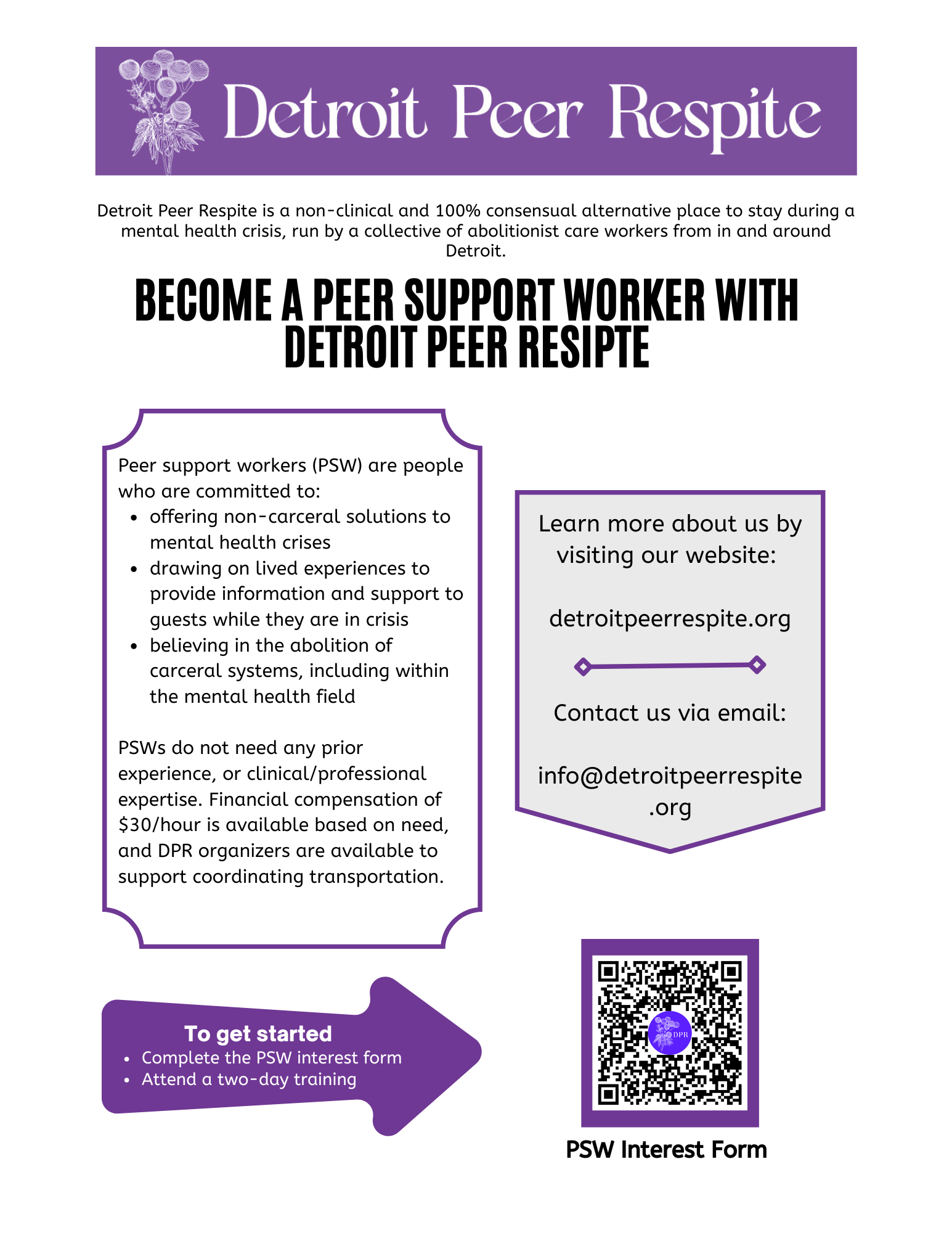
On top of documented recent local tragedies, there’s a lot of published research demonstrating that psychiatric hospitals tend to make people feel worse afterwards, not better. In fact, research shows (as in this study, and this one, and this one) that the 48 hours following discharge from inpatient mental health hospital stays are the highest risk time for suicide attempts — not prior to receiving treatment, as many might suppose (or hope). On the flipside, there’s a growing body of evidence to support the efficacy of the Peer Respite model. The first Peer Respite was attributed to Shery Mead and friends, in the 1990s. To see a short YouTube video documentary giving a pretty good window into what Peer Respite looks like across the country, check out this feature on Afiya House, run by the Wildflower Alliance, in Western Massachusetts.
Peer respites aren’t a place to get “treatment,” because they’re based on the assumption that, regardless of whether or not you have a diagnosis which you believe applies to you, doctors and therapists will never be the expert on how you heal best — you are! And also, you won’t feel better by having all your freedom, belongings, and loved ones taken away — so let’s try something different!
“He maintains that the primary cause of suicide is not individual temperament but forces in the social environment. In other words, suicide is caused primarily by external factors, not internal ones.”
― Huey P. Newton, Revolutionary Suicide
We invite you to learn more about the definition and history of peer respite. You can also find out about Hope 365, a peer respite in Oakland County, MI, as well as Still Waters, a peer respite in Kent County, MI. We’d like to name that our work builds upon the foundations of generations of abolitionist, anti-racist, queer- and femme-led organizing. Some specific organizations led by elders, friends, teachers, and mentors who have directly nurtured our work, and whom we’d like to thank and uplift, include…
- Taproot Sanctuary
- Detroit Safety Team
- Healing By Choice
- Detroit Justice Center
- Michigan Liberation
- National Queer and Trans Therapists of Color Network
- Trans Lifeline
- Transgender Michigan
- Fireweed Collective
- Feedom Freedom Growers
- FIERCE NYC
- Detroit REPRESENT!
- Complex Movements
- Detroit Summer
- The James and Grace Lee Boggs Center to Nurture Community Leadership
 Detroit Peer Respite